


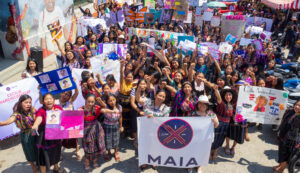
5 Actions By and For Indigenous Women
International Women’s Day. Ensuring Access to Our Rights and Transforming Our Future.
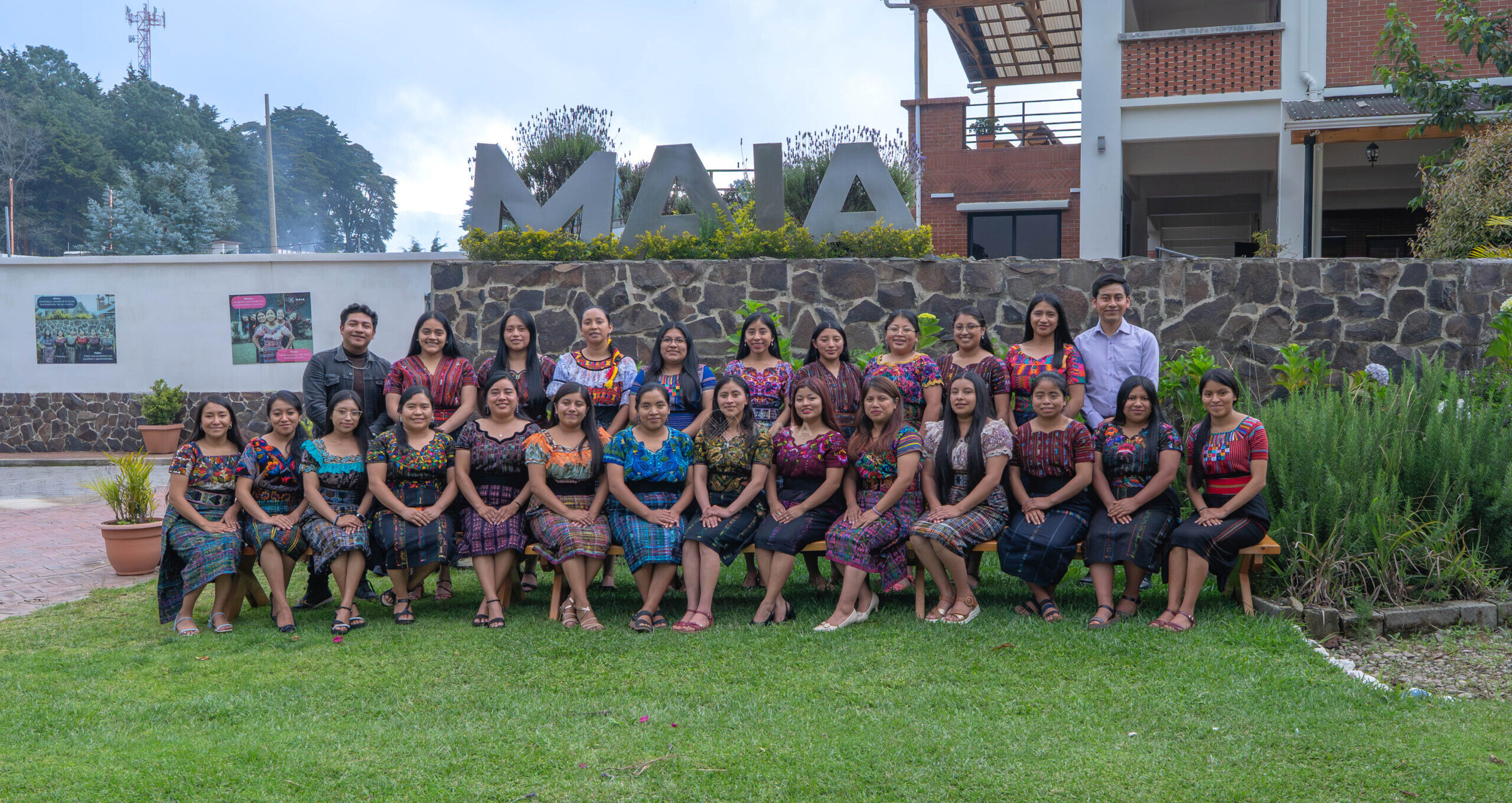
We are a force for change rooted in quality education
When we talk about education, we are not only talking about methods, content, or tests. We are talking about people, about educators who lead diverse classrooms filled with talent and dreams every day. We are also talking about communities that know education can open the door to greater opportunities.
At MAIA, educating means accompanying learning processes with intention, clarity, and purpose. We believe transformative education begins when every learning experience has meaning, direction, and a deep connection to the lives of those who learn.
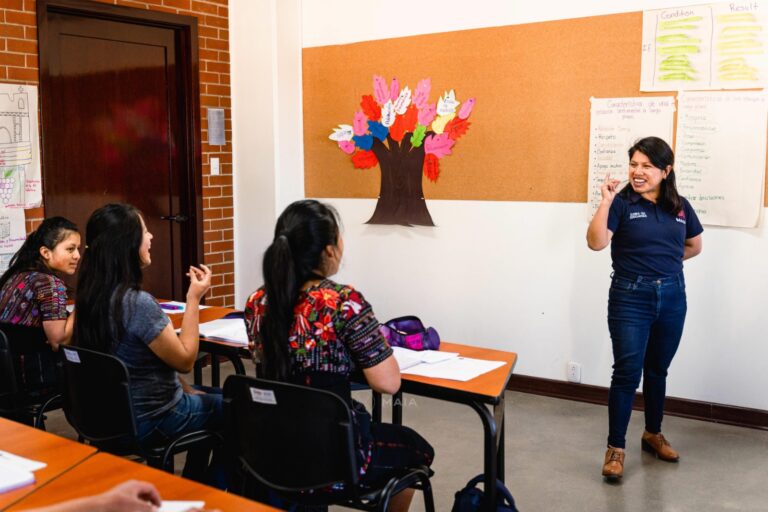
As Celena Cuy, Administrative Co-Director of The MAIA Impact School, explains: “A class at MAIA has a clear and purposeful objective, and educators follow a defined instructional pathway that allows them to know exactly which topics Girl Pioneers need to learn and master.”
This pedagogical leadership—from planning to implementation and conceptual understanding—is what makes it possible to develop real skills and competencies in each Girl Pioneer.
A day at the Impact School begins at 8:00am and ends at 3:40pm. The school day is organized into five subjects, a mid-morning break, and lunchtime. Girl Pioneers move from classroom to classroom, and in each space, they are welcomed warmly, reinforcing a sense of belonging.
Each class begins by recognizing prior knowledge—building on the ideas Girl Pioneers already bring with them—and encouraging the use of an empowered voice. Collaborative work is central, not only as a teaching strategy, but as a way to strengthen collective learning and shared responsibility.
As Vilma Saloj, Director of Strategic Partnerships, describes: “The Girl Pioneer is the protagonist of her own learning.” Educators serve as guides, orienting the process and facilitating access to knowledge, while Girl Pioneers actively construct their own learning.
In every class, three levels of thinking are intentionally developed: literal—understanding what is explicit; inferential—deducing what is implicit by connecting prior knowledge; and critical—evaluating, judging, and forming well-founded opinions.
This journey is supported by methodologies that optimize time, promote deep understanding, and strengthen knowledge retention through games, dynamics, and integrative activities.
Our experience at The MAIA Impact School demonstrates that a different kind of education is possible when Girl Pioneers are at the center. “Our teaching is not based exclusively on content, but on a holistic vision of academic, personal, and social impact, with intentional and consistent practices that place the Girl Pioneer at the center of her learning,” Celena Cuy explains.
The outcomes we see with Girl Pioneers reflect a model with strong potential to be sustained over time. The strategies with the greatest impact are those deeply connected to local context: using everyday commercial situations to teach mathematics or integrating students’ mother tongues into literacy activities. These practices remind us that education becomes more meaningful when it is rooted in daily life.
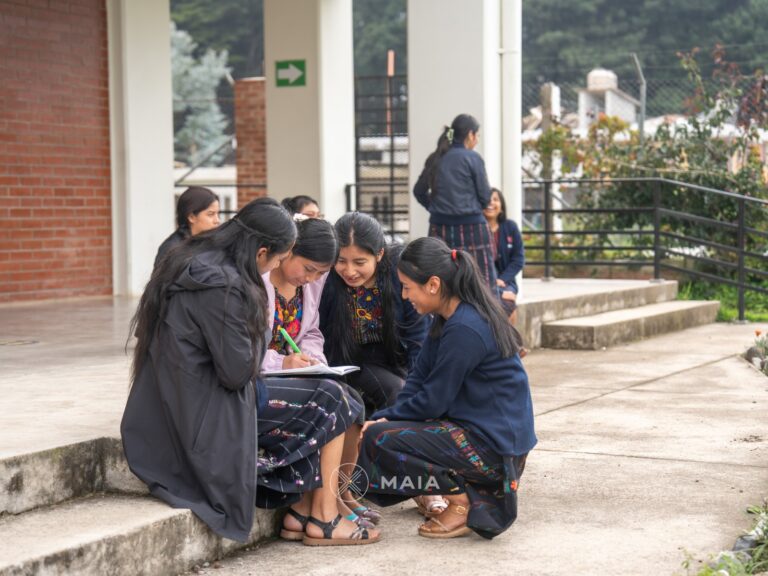
At MAIA, we understand that transforming education also means strengthening those who teach. “MAIA has an internal educator training strategy made up of a diverse set of professional development opportunities; this ensures higher-quality outcomes in the classroom,” shares Andrea Coché, CEO of MAIA.
From this conviction, we desire to share what we learn. As Andrea reflects: “What would happen if we brought together our best practices with those of other organizations also working to improve educational quality?”
This question also responds to needs identified within the public education system. In the words of Víctor Chumil, Educational Supervisor in Sololá: “Within the Ministry of Education, we have significant weaknesses in mathematics and communication and language. We are seeking to raise learning levels, which is why we reached out to civil society organizations that can help us achieve this goal.”
In 2024, we co-founded the Voces para la Educación network, working alongside nine organizations: Glasswing International, Child Aid, Puerta Abierta, School the World, Tierra Nueva, Limitless Horizons, Population Council, COED, ADGN Education, and local education authorities, to reimagine teacher training in Sololá. In 2025 together, we trained nearly 100 educators from 25 communities in literacy, mathematics, and classroom management, with the support of 25 facilitators from partner organizations.
When our practices are shared and placed at the service of the collective, education moves beyond the transmission of knowledge and becomes a force capable of transforming realities.
Learn more about how we are transforming education in the department of Sololá through Voces por la Educación network, in the following video:
When our practices are shared and rooted in community, education moves beyond knowledge. It becomes a force for change that expands opportunities and transforms realities.
International Women’s Day. Ensuring Access to Our Rights and Transforming Our Future.
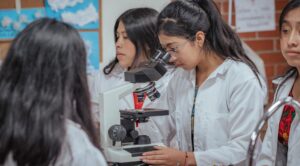
STEM: an engine for transformation How mathematics, logic, technology and science open new possibilities for Girl Pioneers At MAIA, we believe learning goes beyond acquiring knowledge—it’s about developing the ability
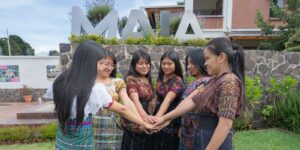
Reflecting on 2025: What Collective Change Made Possible

MAIA USA
Tax Identification Number (EIN) 68-0652444
Asociación MAIA
Tax Identification Number (NIT) 6896913-9.
Guatemala Office:
Km. 137, Caserío Xolbé,
Cantón El Tablón, Sololá, Guatemala
US Office:
Postner Center
1031 33rd Street Denver, CO 80205

Every year at the MAIA Impact School, we welcome a new generation of Girl Pioneers. It is a transformative journey that changes the trajectory of the future of their lives, families, and the broader community.
With your investment, these remarkable young women will break cycles of poverty and build a brighter future.